
How to Search Civil Dockets
Need a Pueblo County civil hearing date? Start with the Colorado Judicial Branch Docket Search. Pick Pueblo County or the 10th Judicial District. Set the date. Then add at least one more filter or the docket search will not run. Court Type splits District Court cases from County Court cases. A division filter tightens the list further. People go in the first and last name fields. A company or other entity belongs under the separate Business option.
What comes back free are hearing cards. They fall short of a full civil register and show no pleading images. CoCourts, a vendor approved by the Judicial Branch, sells real-time register-of-actions data. It covers civil, small claims, domestic, and water matters. For the official paper, turn to the clerk. The clerk issues the ROA, complaint, motion, signed order, judgment, or certification. Each channel answers a different question about a Pueblo County civil docket.
- Decide whether the claim is a District, County, small-claims, eviction, probate, domestic, or municipal matter.
- Search the free docket by date plus case number, party, business, court type, or division.
- Confirm the case class and newest setting on the result card.
- Use an approved vendor to review the longer event history.
- Request the actual document from Pueblo Combined Court.
Pueblo Civil Court Limits
Money sets the boundary. A $15,000 claim line divides Pueblo County Court civil jurisdiction from District Court civil jurisdiction. County Court takes claims up to that limit. It also handles small claims, evictions, and protection orders. Anything above the line goes to District Court. That court also handles domestic relations, probate, mental-health, and Water Division 2 matters. Pick the wrong court and you'll search the wrong docket. The right one determines both the case class and where the docket search must run.
| Court | Typical civil work | Common class |
|---|---|---|
| District Court | Civil above $15,000; domestic, probate, water | CV, DR, PR |
| County Court | Civil up to $15,000; evictions, protection orders | C |
| Small Claims | Informal limited claims within statutory scope | S |
A number like 2025CV30151 folds three things into one string. It packs in the year, class, and sequence. Searching CV in County Court can miss a District case. The reverse fails too. A C or S search in District Court will not catch a County Court matter. When a summons or order names the court, search that court.
What a Civil Docket Shows
A Pueblo County civil docket opens with a case header: court, class, filing date, status, caption, and party roles. From there the chronology may list a complaint or petition, service, answer, disclosure, motion, response, minute order, setting, trial, judgment, satisfaction, enforcement step, or appeal. Each event name is only an index entry. It never replaces the filed page itself.
| Case Header | Case number, court, division, class, filing date, and status. |
|---|---|
| Parties | Plaintiff and defendant, or petitioner and respondent, plus counsel where public. |
| Event History | Filings, service, motions, minute orders, hearings, and rulings in date order. |
| Setting | Date, time, duration, hearing type, location, appearance type, and courtroom. |
| Judgment | Entry noting the result; authoritative terms remain in the signed order. |
| Financial Activity | Costs or judgment-related activity where entered. |
A Case Management Conference handles scheduling and issue management. It is not a trial. A Court Trial, by contrast, puts the case before the judge for decision. A VIRTUAL label covers remote appearance. It works for that one event only. Trust the newest order and live setting over an old calendar line.
Pueblo Civil Filing Volume
FY2024 statistical data reports 5,794 Pueblo County Court civil filings. Within that total sit 3,432 money-demand matters and 1,233 forcible-entry-and-detainer filings. FED is simply the court's term for an eviction case. Name changes and protection-order entries round out the mix. These are filing counts, not judgments or successful claims.
That volume shows why court type, case class, and date filters matter so much. Limited civil, eviction, small-claims, and protection-order work all share the County Court system in Pueblo. A broad party search on a busy date can bury you in hearing cards, while a case number leads straight to the relevant Pueblo County civil docket.
Types of Civil Cases on the Docket
Several case paths run through Pueblo County civil court dockets. Contract and money-demand suits use plaintiff and defendant roles. Domestic, probate, and some special proceedings use petitioner and respondent instead. Small claims carry a simplified case class. Evictions show up as FED matters. Protection orders can carry civil entries even when related events sit elsewhere.
| Case type | Likely court | Entries to check |
|---|---|---|
| Money or contract claim | County or District, based on jurisdiction | Complaint, service, answer, motion, judgment |
| Small claim | County Court | Claim, service, setting, disposition |
| Eviction / FED | County Court | Complaint, summons, return, judgment |
| Domestic or probate | District Court | Petition, order, hearing, protected-access status |
Pueblo Combined Court is the clerk for both state trial levels. Pueblo Municipal Court, by contrast, mostly handles city-code violations and traffic cases rather than private civil suits. The elected Pueblo County Clerk and Recorder keeps deeds and recorded instruments, not court pleadings.
Pueblo Eviction Docket Timing
Pueblo posts FED matters on Monday and Thursday at 8:30 a.m. Treat that recurring calendar as context only. The written summons and current case setting control. Holidays, a judge's order, or a case-specific reset can move any event. Check the free calendar with the Pueblo case number and date in hand.
An older setting may linger in the register after a continuance. An ROA preserves event history. Hunt down the newest order and the current calendar card. If the two conflict, call Pueblo Combined Court at 719-404-8700. The division line in the official staff directory also works. Staff can confirm administrative facts, though they cannot choose a legal response for a party.
Note: A recurring time never replaces case dates. The date and instructions written in a case-specific court order control.
Settings and Hearings on Civil Dockets
Civil settings show what the court plans to address. Pueblo civil calendars list common events. Examples include Case Management Conference, Review With Appearance of Parties, Setting, and Court Trial. Each card can carry a date, start time, and duration. It may also show court location, appearance type, and courtroom or division. Those details help a party prepare for the right event.
- Case Management Conference
- A scheduling and issue-management event, not a final trial.
- Setting
- A scheduled court event identified by the calendar.
- Minute Order
- A short court-entered record of a ruling or proceeding.
- Continuance
- An order moving a setting to another date.
- Default Judgment
- A judgment that may be entered when a responding party does not defend as required.
One event card does not rule out other filings. Check CoCourts for the fuller timeline of a Pueblo County civil docket. When you need the actual terms of a ruling, order the signed copy from the clerk rather than trusting the card. A VIRTUAL label applies only to that event. Follow its own remote instructions, and do not assume the whole division sits remotely.
Pueblo Civil Orders and Fees
Start with the Judicial Branch request form, which lists three separate products: an Order for Judgment, a Transcript of Judgment, and a Satisfaction of Judgment. They are not interchangeable. The order states the court's ruling. A transcript of judgment, a $25 clerk product, evidences the judgment itself. Recording satisfaction the proper way takes a $20 certificate.
Copies run $0.25 per page, electronic or paper. Certification or exemplification is $20 per document, and a name search is $5. Work past the first hour, whether research or redaction, costs $30 per hour billed in 15-minute increments. Off-site retrieval is billed at actual cost. The official Colorado filing-fee list posts the separate fees charged when a matter is filed.
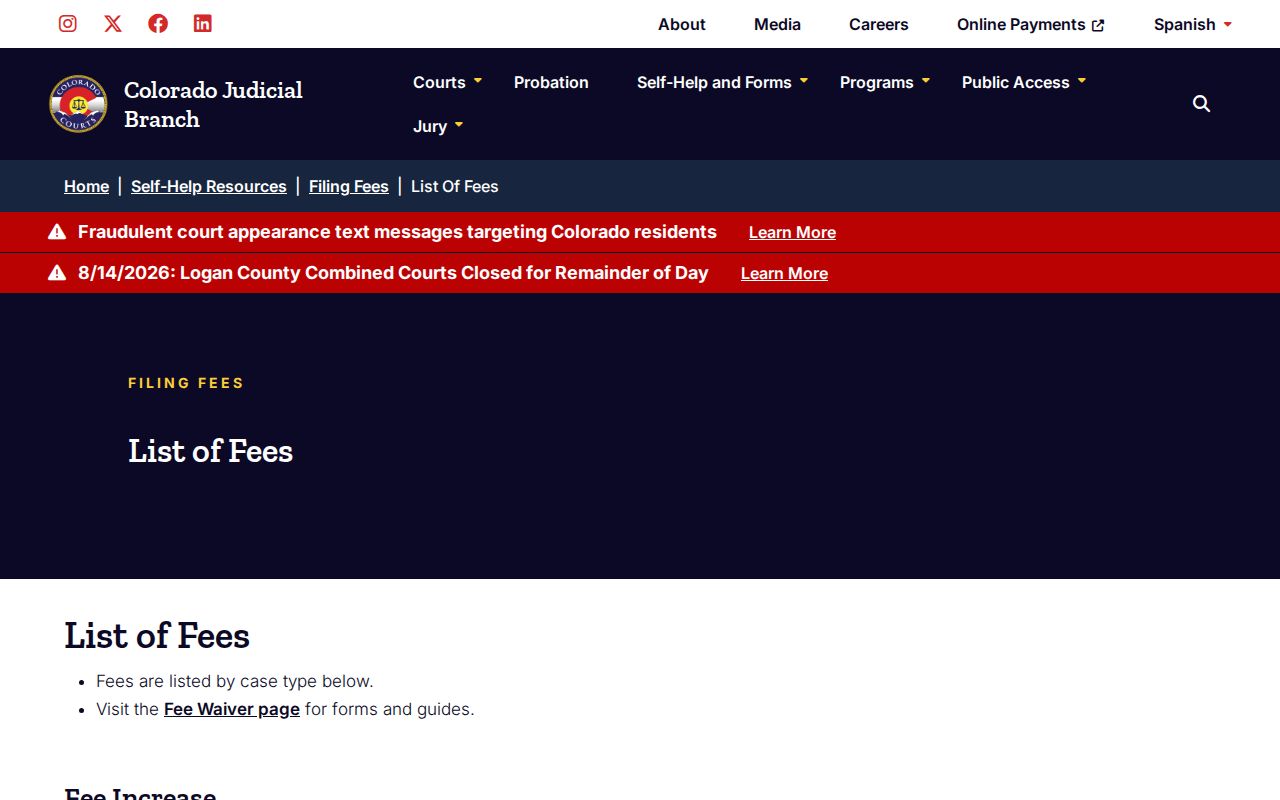
That statewide schedule sets the filing side. Copy and certification charges come from the current record-request channel instead. Confirm the total with the clerk before ordering a large file.
Public Access to Civil Dockets
Chief Justice Directive 05-01 sets the ground rules for access to Colorado court records. A public civil docket may be searchable while certain documents or identifiers stay protected. Juvenile, adoption, dependency, protected family, mental-health, and parts of probate records can require proof of entitlement or a court order. Expect remote access to be narrower than what you get at the counter.
Every documented route still works. The free hearing calendar shows court dates. An approved vendor supplies a register of actions, and the statewide form retrieves filed documents. The Records Department at 501 N. Elizabeth Street takes visitors from 8:00 a.m. to 4:00 p.m. weekdays. Call 719-404-8700, or Clerk Leanna Salazar at 719-404-8963. Confirm mail or delivery instructions with the clerk first. Bring a photo ID for protected material.
Civil record access: The Colorado Open Records Act governs many agency records, but individual court-case access follows CJD 05-01 through the court clerk.
Pueblo Municipal Appeal Route
A civil reader in Pueblo County sometimes hits a City of Pueblo ordinance judgment. That is different from an ordinary civil suit. Pueblo Municipal Court is a qualified court of record. Its appeal route runs to Pueblo District Court within 35 days. Colorado law and municipal rules govern that path. There, the existing record gets reviewed rather than retried from scratch. The Judicial Branch posts the municipal court appeal routes, forms, deadlines, and fees.
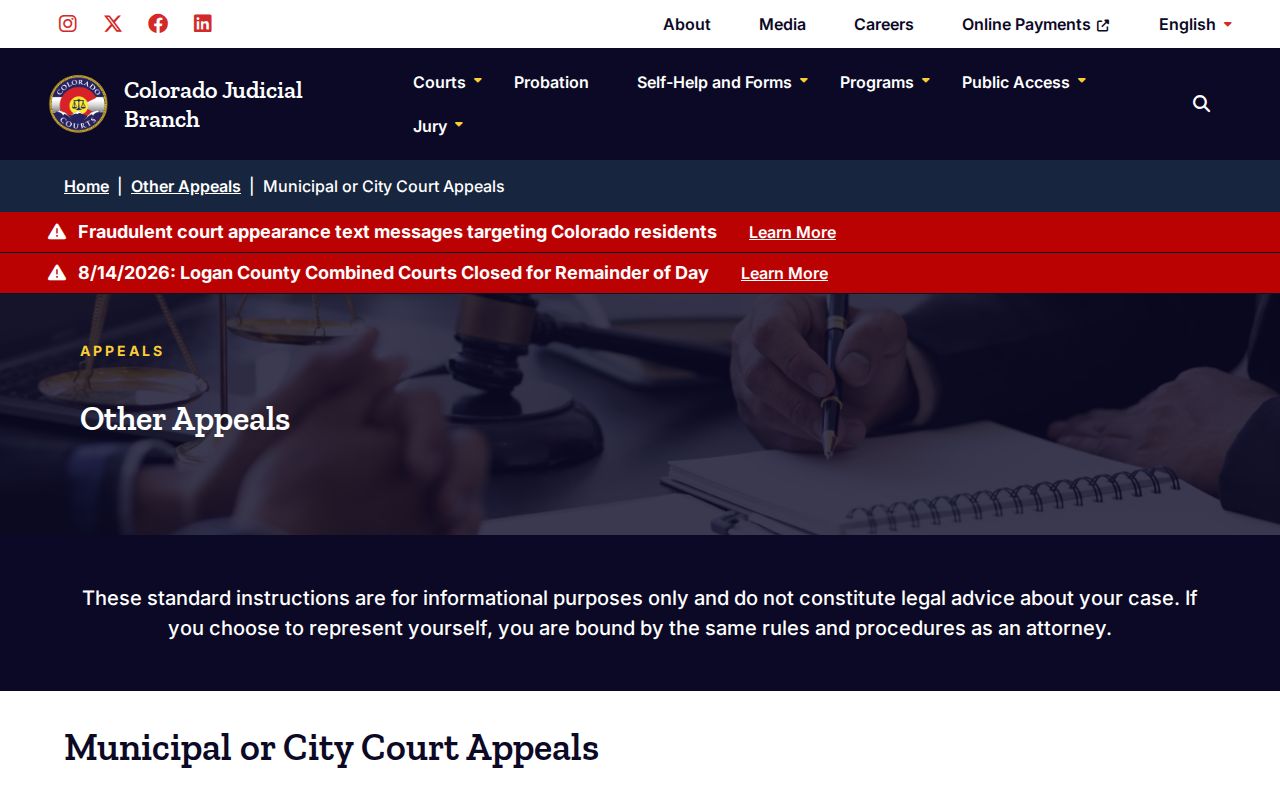
That appeal material helps you tell the municipal record apart from the later District Court docket. When an appeal has been filed, search both case numbers. Ordinary County Court civil appeals also climb into District Court, adding a second layer of entries.