
How to Search Criminal Dockets
Free lookup starts with the Colorado Judicial Branch Docket Search. Pick Pueblo County or the 10th Judicial District. Choose a date, and then add a filter such as case number, party, court type, division, or attorney. The form demands a date plus at least one more filter. Felonies sit in District Court. State misdemeanors sit in County Court. City ordinance and municipal traffic cases run through Pueblo Municipal Court instead.
One tool is rarely enough. The free site lists scheduled events, not the full register or document images. For a real-time register of actions on a charge, an approved vendor like CoCourts fills the gap. Vendor terms and fees apply, and its output is not the official record. The Pueblo Combined Court clerk remains the source for the official register, pleadings, orders, and certified dispositions.
- Identify District, County, or Municipal Court from the charge or citation.
- Search the state docket by date plus case number, party, division, or court type.
- Open the matching setting and compare the case class, courtroom, and appearance type.
- Use an approved vendor for the chronological register of actions.
- Ask the proper clerk for the filed order or a certified copy.
Pueblo Criminal Case Classes
Case numbers in a Pueblo County criminal docket tell you which court path a charge follows. Take 2025CR712: the year comes first, CR marks a District Court criminal case, and the sequence closes it out. County Court misdemeanors carry an M. State traffic uses T. Knowing that little code saves you from searching the wrong court.
- CR
- District Court criminal class, commonly used for felony matters.
- M
- County Court misdemeanor class.
- T
- County Court state traffic class.
- ROA
- Register of Action, the chronological case summary.
Skip spaces unless the search form asks for them. When a case number fails, break it into year, class, and sequence across the state fields. City of Pueblo cases may never show up in the state system at all, so check the municipal docket or call its clerk.
What a Criminal Docket Shows
A Pueblo County criminal docket mixes allegations, settings, release terms, and the outcome. So read every field in context. A charge is only an accusation, not a conviction. A hearing label tells you what was scheduled, not what the judge ordered. For the result itself, the signed disposition or sentence order is the best source.
| Case Number | Year, CR, M, or T class, and sequence. |
|---|---|
| Charge | Offense description and classification shown in the ROA. |
| Setting | Date, time, duration, hearing type, appearance mode, and courtroom. |
| Bond | Release amount, conditions, and Pueblo bond code where entered. |
| Disposition | Plea, dismissal, conviction, sentence, or other final action. |
| Documents | Entries may name documents, but copies must be requested from the clerk. |
Fines, fees, restitution, and collections activity can appear in financial entries. Those live apart from the court's payment system. Appeal entries may cite a new case number, and that appeal must be searched as its own docket.
Pueblo Criminal Bond Codes
Pueblo Combined Court lists seven local bond codes. They are CO, CS, CONS, CSP, SUR, PR, and PRC. Each one describes the form of release security. None of them speaks to guilt, innocence, or disposition. So read a bond entry apart from the charge and sentence fields. The official Pueblo judges and staff directory lists current divisions and court contacts.
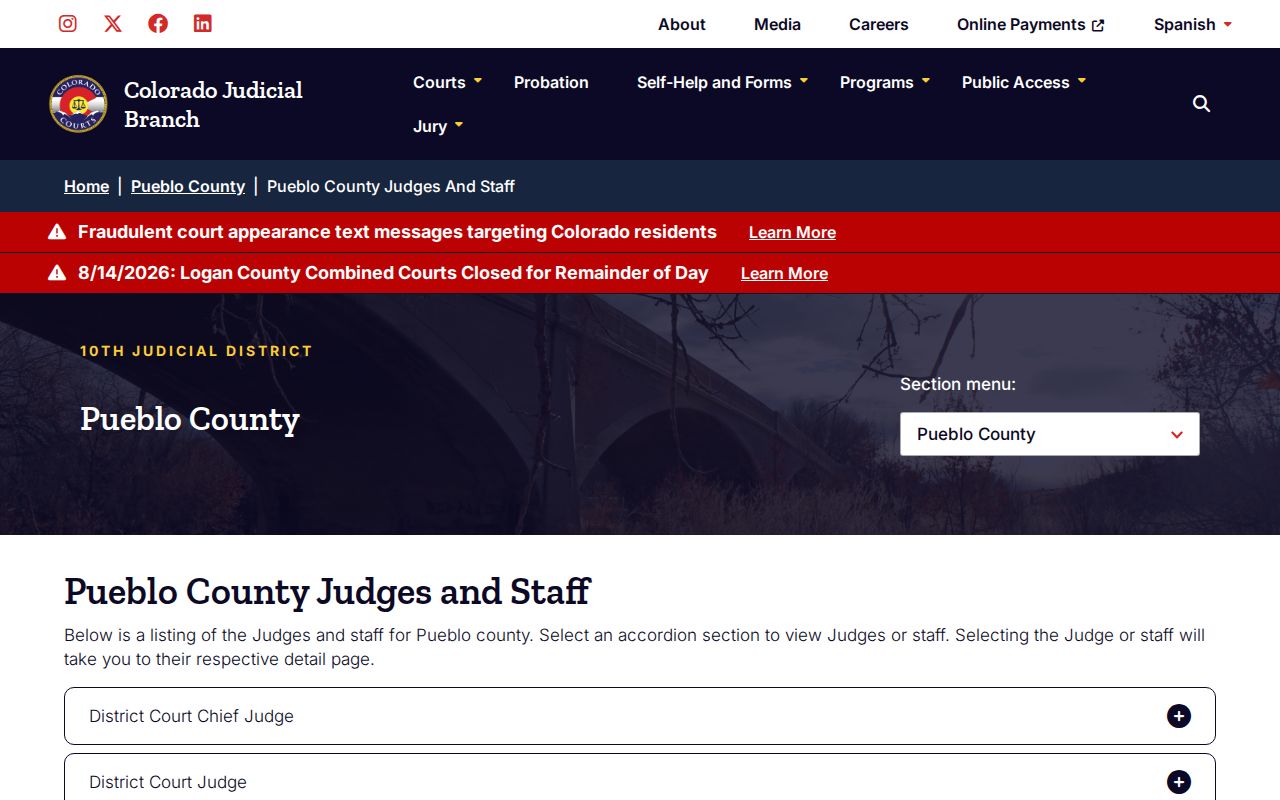
That directory helps you match a division on a Pueblo County criminal docket to the right administrative line. Court staff cannot give legal advice, though.
- CO
- Cash only.
- CS
- Cash or surety.
- CONS
- Cash only, no surety, defendant only.
- CSP
- Cash, property, or surety.
- SUR
- Professional surety.
- PR / PRC
- Personal recognizance, with PRC requiring a co-obligor.
Stages on a Criminal Docket
A typical Pueblo County criminal docket opens with a complaint or information. Advisement and bond activity often follow. The response to the charge gets recorded at arraignment or a plea hearing. Then pretrial settings, motions, and orders fill out the middle of the register. A plea or trial moves things toward disposition and sentencing. An appeal adds entries. It may also spawn a second case number.
Docket flow: Charge Filed › Advisement and Bond › Arraignment › Pretrial Settings › Plea or Trial › Disposition › Sentence
A "Plea Sentencing Hearing" label is still just calendar language. It proves neither the plea entered nor the sentence imposed. Confirm with the later minute order. The ROA and the signed disposition help too. Resets can also leave earlier dates sitting in the history.
Pueblo Disposition Order Requests
Need official proof of an outcome? Request the Disposition/Sentence Order through the state Record/Document Request Form. The form takes a case number, contact and address details, and a criminal-document selection. It also needs an "other documents" description and a certification choice. An electronic court copy runs $0.25 per page. Certification or exemplification adds $20 per document, plus any copy charges.
The clerk usually answers within three business days absent extenuating circumstances. That timing is not a delivery promise. Old files may need actual-cost off-site retrieval. Transcripts take a different route through 10CourtReporter@judicial.state.co.us. There you state the case number, hearing date, judge or division, and the portion you need.
Counter, phone, and online options all work. Pueblo Combined Court's Records Department sits at 501 N. Elizabeth Street, Pueblo. Its window is open 8:00 a.m. to 4:00 p.m. weekdays. Call 719-404-8700, or the Clerk of Court at 719-404-8963, before traveling for an old, protected, or urgent file.
Which Court Holds Criminal Dockets
Felony dockets belong to Pueblo District Court. State misdemeanors and traffic dockets belong to Pueblo County Court, and both run through Pueblo Combined Court in the 10th Judicial District. Pueblo Municipal Court handles City Charter, ordinance, parking, city traffic, and qualifying concurrent-offense dockets, with its own clerk and daily calendar.
| Court | Criminal scope | Primary access |
|---|---|---|
| District Court | Felonies | State docket, ROA vendor, Combined Court clerk |
| County Court | Misdemeanors and state traffic | State docket, ROA vendor, Combined Court clerk |
| Pueblo Municipal Court | City ordinance, parking, city traffic | Today's Docket, calendar, municipal clerk |
Don't bring your criminal docket question to the elected Pueblo County Clerk and Recorder. That office keeps land and county records, and its recorded-document search won't surface a prosecution. Trials live elsewhere in the Pueblo County court system. County Court appeals travel up to District Court. Pueblo Municipal Court is a qualified court of record, and because of that its appeals also reach District Court through the record-review route that applies there.
Pueblo Municipal Warrant Dockets
Warrants tied to City violations run through a separate municipal warrant information channel maintained by the City of Pueblo. It covers City cases only. A Pueblo County warrant from a state court won't show there.
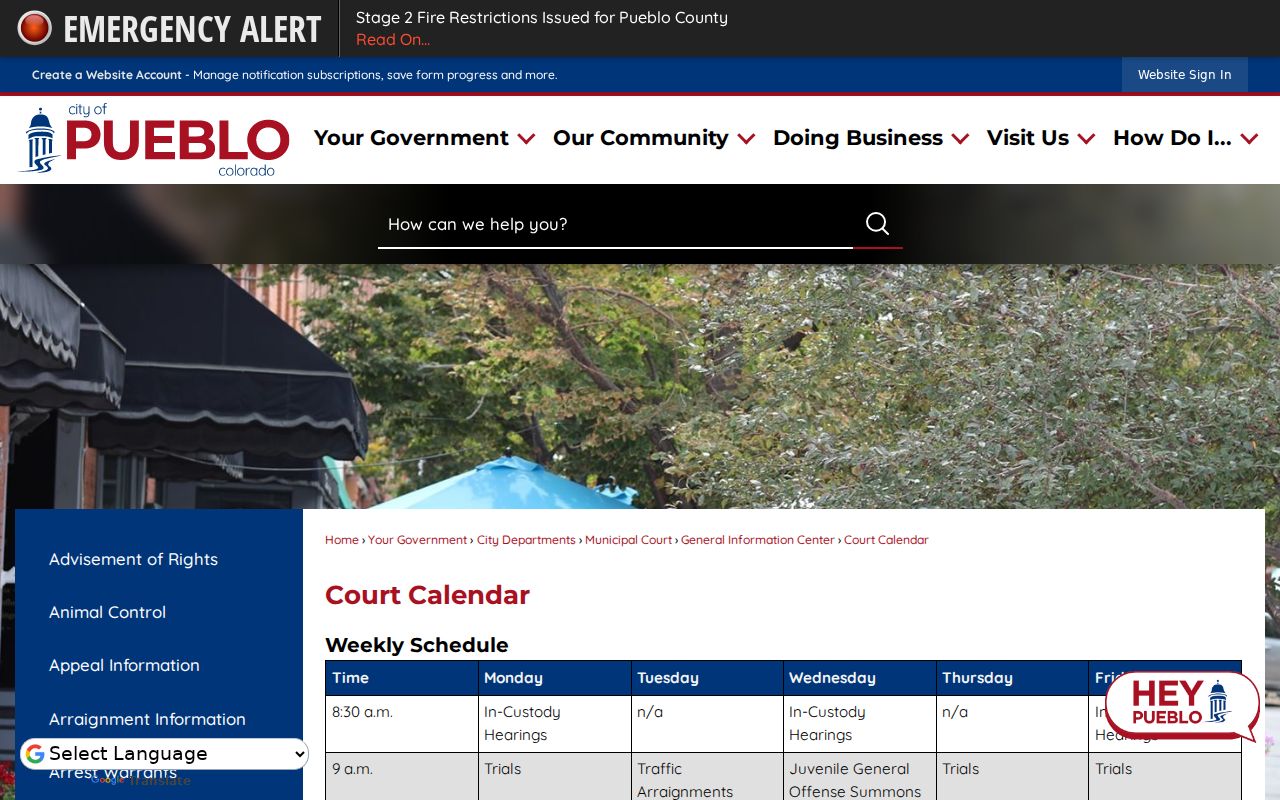
The issuing court comes first when you use any warrant page or calendar. That split is why. If a City case is missing, call the municipal clerk at 719-562-3810. For a state case, call Pueblo Combined Court instead. And treat nothing as settled. Paying online, finding no calendar result, or seeing an old setting does not clear a warrant.
Pueblo Criminal Filing Context
Court type matters in Pueblo County criminal docket searches. The official March 2025 district summary shows it in hard numbers. The 10th Judicial District received 6,767 new District Court filings in FY2024. It also took 13,205 County Court filings across its full mix. County Court alone handled 402 DUI or DWAI filings and 598 domestic-violence cases. Two County judges carried the traffic and misdemeanor workload.
Read those as filing counts, nothing more. They are not findings of guilt. Pueblo judges also sit on mixed assignments, so the division printed on a Pueblo County criminal docket often tells you more than any assumption about a single dedicated criminal courthouse. The official directory counts eight District judges, three County judges, and four magistrates on the local bench. Specialty dockets sit inside that structure. The district runs a Behavioral Health Court and a Veterans Treatment Court with probation; the first began in 2013, the second in February 2015. Both are case-management tracks, not separate conviction categories or public participant lists. A participant's hearings stay tied to the underlying criminal case number, so search the ordinary Pueblo County criminal docket and ROA first, then ask the court or the probation program for administrative detail. Clinical and treatment facts don't become public just because a program setting appears.
Public Access and Sealed Criminal Dockets
Colorado opens its court records under Chief Justice Directive 05-01, and that rule drives what a Pueblo County docket search can return. Remote access is the narrow door. The clerk's counter sees more than any online docket does. Sealed or suppressed cases simply will not appear in a public search, and juvenile files plus protected slices of probate and family matters carry their own extra walls.
If you believe a case exists, take it to the clerk directly. Bring the case number, the year, the case type, and the location, along with your date of birth and photo identification if asked. The statewide request form, the clerk counter, and the telephone all work when an online docket search comes up empty. An empty result is not proof that no case exists. Before drawing that conclusion, recheck the spelling, the date, the court class, and the split between municipal and state court.
Key Rules:
C.R.S. §§24-72-701 through 24-72-710 establish criminal-record sealing routes and limit public availability after sealing.
C.R.S. §19-1-304 restricts juvenile-record access and protects identifying details.